Are your books Healthy?

Is Your Bookkeeping Helping Your Business Grow—or Holding It Back?
Is your bookkeeping healthy?

Bookkeeping is one of those things most business owners don’t think about until there’s a problem.
Unfortunately, by the time issues show up on a tax return, a cash flow report, or during an audit, they can be expensive and time-consuming to fix.

That's exactly why I'm offering a Free Bookkeeping Health Check.

I check 10 areas in your bookkeeping file and report back to you on what's good, what's not and what needs immediate attention

At AccountingMD, I help business owners uncover bookkeeping problems before they become major headaches. Whether you do your own bookkeeping, have an employee handling it, or work with another service provider, a professional review can provide valuable insight into the true health of your financial records.

Why Your Bookkeeping Health Matters

Your bookkeeping isn’t just about keeping CRA happy. It’s the foundation for nearly every important business decision you make.

When your books are accurate, you can:

  • Understand your true profitability
  • Make informed pricing decisions
  • Monitor cash flow with confidence
  • Prepare for tax season without stress
  • Access financing more easily
  • Plan for future growth

When your books contain errors, however, the numbers you rely on may be misleading. Small mistakes can snowball into larger problems that affect your business performance and peace of mind.

What Is Included in the  10-Point Free Bookkeeping Health Check?

My review examines key areas that provide a clear picture of your bookkeeping health.

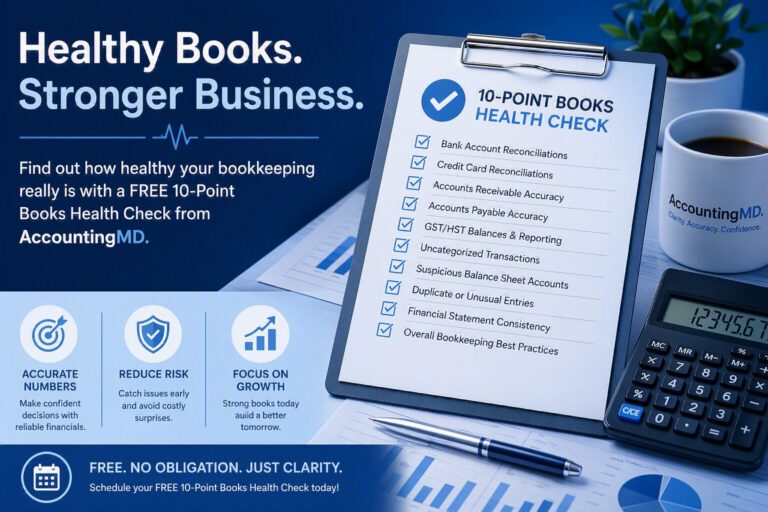
The assessment includes checks such as:

✅ Bank account reconciliations

✅ Credit card reconciliations

✅ Accounts receivable accuracy

✅ Accounts payable accuracy

✅ GST/HST balances and reporting

✅ Uncategorized transactions

✅ Suspicious balance sheet accounts

✅ Duplicate or unusual entries

✅ Financial statement consistency

✅ Overall bookkeeping best practices

After the review, you’ll receive clear feedback on what is working well and what may need attention.

Why Work With me?

Unlike automated software diagnostics, this review is performed by an experienced bookkeeping professional (me) who understands how real businesses operate.

My goal isn’t to overwhelm you with accounting jargon. I focus on providing practical insights that help you:

  • Improve financial accuracy
  • Reduce risk
  • Save time
  • Avoid costly clean-up projects later
  • Gain confidence in your numbers

Most importantly, you’ll learn whether your bookkeeping systems are supporting your business goals—or creating unnecessary risk behind the scenes.

There Is No Obligation

The Free 10-Point Books Health Check is exactly that—free.

There is no obligation to engage my services afterward. You simply receive an objective evaluation of your books and actionable recommendations to help strengthen your financial records.  

Think of it as a wellness check for one of the most important assets in your business: your financial data.

Ready to See How Healthy Your Books Really Are?

If you’ve ever wondered whether your bookkeeping is accurate, up to date, and giving you the information you need to make confident business decisions, now is the perfect time to find out.

Contact me today to schedule your Free 10-Point Books Health Check and get a clear picture of the health of your bookkeeping.

Your business deserves financial records you can trust. Let’s make sure that’s exactly what you have.

Cleanup vs Catchup Bookkeeping

Cleanup vs Catchup bookkeeping - whats the difference?

You’ve been meaning to get to your bookkeeping, but you keep putting it off. The pile of receipts and invoices on your desk is getting bigger and bigger, and your anxiety is growing with it. Don’t worry; you’re not alone! Many business owners fall behind on their books.

When you’re ready to get back on track, I can help. I offer two services that will get your finances in order and your peace of mind back:

Catch-Up Bookkeeping and Clean-Up Bookkeeping.

What’s the difference?

  • Catch-Up Bookkeeping: Think of this as filling in the gaps. If you have months (or years) of unrecorded transactions, we’ll work together to enter everything into your accounting system so your records are current and complete.
  • Clean-Up Bookkeeping: This service is for when your books are incomplete and filled with errors. Whether it’s due to incorrect entries, duplicate transactions, or an unorganized chart of accounts, I’ll clean up the clutter and get your books accurate and reliable.

Often, businesses need both services to get completely caught up. A backlog of unrecorded transactions can easily lead to a disorganized and error-prone accounting system.

Happy and calm business owner

Ready to clear the clutter and get your books in shape? Let’s chat and create a plan to get your business finances organized and stress-free. Send me a message, and let’s get started! 

What’s the right accounting software for your small business?

Pick the right accounting software for your small business

Cloud accounting expert

I get this question a lot, maybe its because I am an accountant/bookkeeper, maybe its because of my IT background, or just people don’t really know.

I don’t think there is any one answer for people it really depends on your needs.  Read on for some tips that may help you decide.

Synoptic Journal

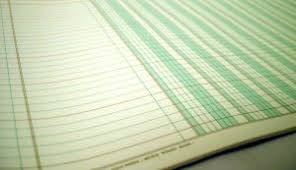
This is a paper based ledger, you may have seen them it is large binder with a page for each month.  This is the ultimate in low tech.  Don’t really see these too much anymore but you can still buy the ledger books. 

Best for – someone who doesn’t want to use a computer. Very inexpensive.

Drawback –  It might be hard to find an accountant to work with a paper based system. It is also easy to make mistakes. It also really only tracks income and expenses so your accountant will have to have a system to track any balance sheet items like equipment, loans etc separately.

Excel

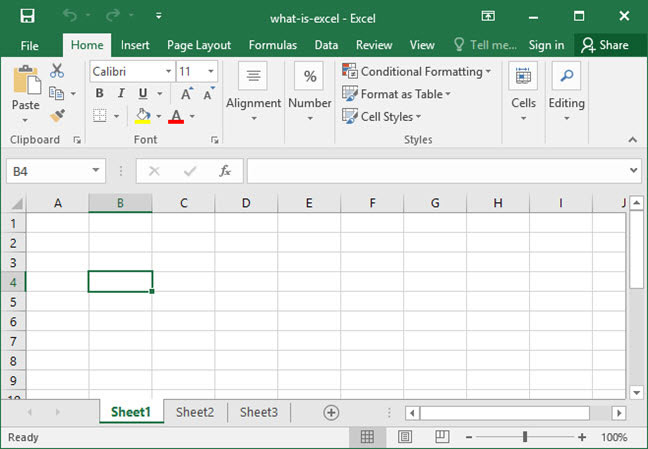
This is typically an computer version of the synoptic journal.  These usually come from smaller businesses who have simple needs.  Think consultant or a small service provider.

Best for – business owners with a simple, low volume business. Because it is excel it is easy to find templates online and easy to add up the numbers.

Drawback – It is excel and this type of accounting method doesn’t scale well if your business gets complicated. While there are more options to track the balance sheet items, typically like a synoptic journal these are tracked separately at tax time.

Desktop Software

Accounting software for the desktop has been around for a very long time.  While most of the accounting software providers are encouraging migrating to the cloud, there is still a large component of businesses who prefer to work on the desktop.  The most common ones are Sage 50 and QuickBooks Desktop but there are a number of ‘free’ or ‘almost free’ options. A few like Sage 50 cloud and AccountEdge are ‘hybrid’ which have a desktop component but ‘sync’ to the cloud.

Best for – Bookkeepers or businesses that have multiple companies and individuals who don’t want to work in the cloud.  Because of the need to roll out updates, the software is more consistent to use and changes to the software can be managed.  As it is on your desktop theoretically it can be used where there is no internet (however some companies require an internet connection to verify licensing).  Many bookkeepers prefer desktop software because of the ability to pay once and use it for multiple companies.

Drawbacks –  Can be challenging to share the software, updates and backups have to be managed by the end user.  The software is ‘tied’ to a specific computer and typically there is a process to setup a new computer.

AI Bookkeeping Solutions

Cloud Based software

This is the newest advance in accounting methods.  Xero was the first main cloud accounting software (CAS) provider first launching in 2006.  QuickBooks started offering cloud accounting software in the early 2000s and Sage offered an online version in the mid 2010s.  There are other cloud accounting software providers like  Zoho, Wave, Freshbooks, Odoo to name a few but Xero and QuickBooks are the most popular.

Best for – Businesses who want to work in the cloud and be location independent. It is easy to share the software with team members and accountants.  Various apps are available to extend the functionality of the software and reduce the amount of manual data entry.  Backups and updates are managed by the software provider.  The software can be used in any location and isn’t tied to a specific computer.

Drawbacks – each company is setup individually so there can be more cost for the accounting software. There is no control to how often changes are made or features updated, and this can be frustrating to the person using the software.  An internet connection is mandatory to be able to use cloud accounting software.

Summary

So there are a lot of options when deciding the accounting method that works for you. Your method may end up being decided by the accountant or bookkeeper you use.  Just remember regardless of the method, most tax authorities require you to keep a copy of your business receipts for 7 years.  How you do that is outside the scope of this post but watch for another post on ways to  store business document receipts.

Bookkeeping FAQs for Canadian Small Business

Not sure which is the best method for your small business? Reach out and we can help you decide.

Proudly Canadian

Accounting MD is proudly 100% Canadian.  All service providers are accredited Canadian Financial Professionals. No portion of our work is outsourced outside of Canada.